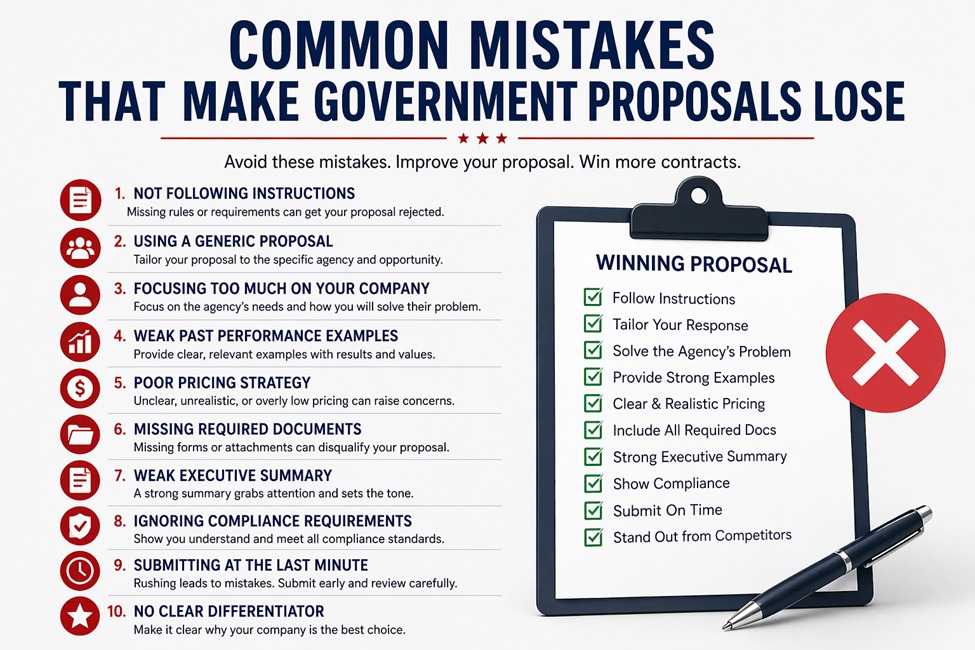
Winning a government contract is not just about offering a great service or the lowest price. Many businesses lose contracts because of simple proposal mistakes that could have been avoided.
A strong government proposal must be clear, complete, and fully aligned with what the agency asks for. Even experienced companies lose opportunities when they overlook small details.
The truth is simple. Government buyers are not looking for the fanciest proposal. They are looking for the safest and most reliable choice.
In this guide, we will break down the most common mistakes that make government proposals lose and how your business can avoid them.
Why Government Proposals Fail
Many business owners think losing means their company was not good enough. That is not always true.
Often, the problem is the proposal itself. A great company with a weak proposal can lose to an average company with a strong, well-structured submission. Government contracting is about trust, compliance, and proof. If your proposal creates confusion, risk, or extra work for the evaluator, your chances drop fast. That is why avoiding common mistakes matters so much.
Mistake 1: Not Following Instructions
This is the biggest mistake, and it happens all the time. Every solicitation includes rules.
These may include:
- Page limits
- Font size
- File format
- Required forms
- Submission deadlines
- Pricing structure
- Technical response format
If the agency asks for 10 pages and you send 15, that can hurt you.
If they ask for a PDF and you send a Word, that can create problems. Always follow instructions exactly. Government buyers notice details.
Mistake 2: Using a Generic Proposal
Some companies send the same proposal to every opportunity. That rarely works. Each contract is different. Each agency has different needs, risks, and goals. Your proposal should feel written for that specific contract.
It should answer:
- What does this agency need?
- Why are we the right fit?
- How will we solve their problem?
A generic proposal feels lazy. A tailored proposal builds confidence.
Mistake 3: Focusing Too Much on Your Company
Many proposals spend too much time talking about the business and not enough time solving the agency’s problem. The buyer is not asking:
“How great is your company?”
They are asking:
“Can you help us succeed?”
Shift the focus. Instead of saying:
“We have 20 years of experience.”
Say:
“Our 20 years of experience helps us reduce project delays and improve delivery speed for your team.”
Always connect your experience to their outcome.
Mistake 4: Weak Past Performance Examples
Government buyers want proof. They need to see that you have done similar work before. Some companies list projects that are too vague. Others choose examples that do not match the scope.
Strong past performance should include:
- Client name
- Project type
- Contract value
- Time period
- Results achieved
The closer the example matches the current opportunity, the better. Specific proof beats general claims.
Mistake 5: Poor Pricing Strategy
Low pricing does not always win. In fact, pricing that looks too low can create concern. The agency may think:
Can this company really deliver at this price?
Pricing should be realistic, clear, and defensible.
Avoid:
- Random price guessing
- Missing cost details
- Underpricing just to compete
- Confusing pricing tables
Your pricing should show value, not desperation.
Mistake 6: Missing Required Documents
This happens more than people expect. A proposal may look strong, but gets rejected because one required form is missing.
Examples include:
- Representations and certifications
- Past performance forms
- Pricing sheets
- Technical attachments
- Small business certifications
- Signed documents
Use a checklist before submitting. Never assume everything is included. Double-check every file.
Mistake 7: Weak Executive Summary
The executive summary is often the first thing evaluators read. If it feels weak, the rest of the proposal starts with a disadvantage.
A strong executive summary should quickly explain:
- What problem does the agency need to solve
- Your solution
- Why your company is the best fit
- The value you bring
It should be clear, direct, and easy to understand. Avoid long introductions with no purpose. Start strong.
Mistake 8: Ignoring Compliance Language
Government contracts often include compliance requirements.
These may involve:
- Security standards
- Labor requirements
- Cybersecurity rules
- Insurance levels
- Reporting obligations
- Federal regulations
If your proposal ignores these, the buyer sees risk. Show that you understand compliance and already have systems in place. Confidence grows when risk goes down.
Mistake 9: Submitting at the Last Minute
Rushing creates mistakes.
Late-night proposal work often leads to:
- Missing attachments
- Wrong file uploads
- Broken formatting
- Missed instructions
- Deadline failures
Government deadlines are strict. Late usually means disqualified. Submit early whenever possible. Leave time for review.
Mistake 10: No Clear Differentiator
Why should they choose you? If your proposal cannot answer that clearly, it becomes forgettable.
Your differentiator may be:
- Faster delivery
- Specialized certifications
- Stronger local presence
- Better reporting systems
- Unique technical expertise
- Proven federal past performance
Do not assume the evaluator will figure it out. State it clearly. Make your value easy to see.
How to Improve Your Proposal Win Rate
Avoiding mistakes is the first step. Improving your process is the second.
Here are simple ways to improve:
- Build a proposal checklist
- Review old winning proposals
- Study agency buying patterns
- Use strong templates but customize every response
- Ask for debriefs after losses
- Improve your capability statement
- Practice writing stronger executive summaries
Proposal success improves with discipline. Every loss can teach something useful.
Final Thoughts
Common mistakes that make government proposals lose are often simple, but they are expensive. A missed form, weak example, or rushed submission can cost your business a major contract.
Winning proposals are not just about writing well. They are about trust, clarity, proof, and following instructions.
- Take time to understand the requirement.
- Build your response around the agency’s needs.
- Show proof.
- Stay compliant.
- Submit professionally.
In government contracting, small mistakes can create big losses. But small improvements can create big wins.