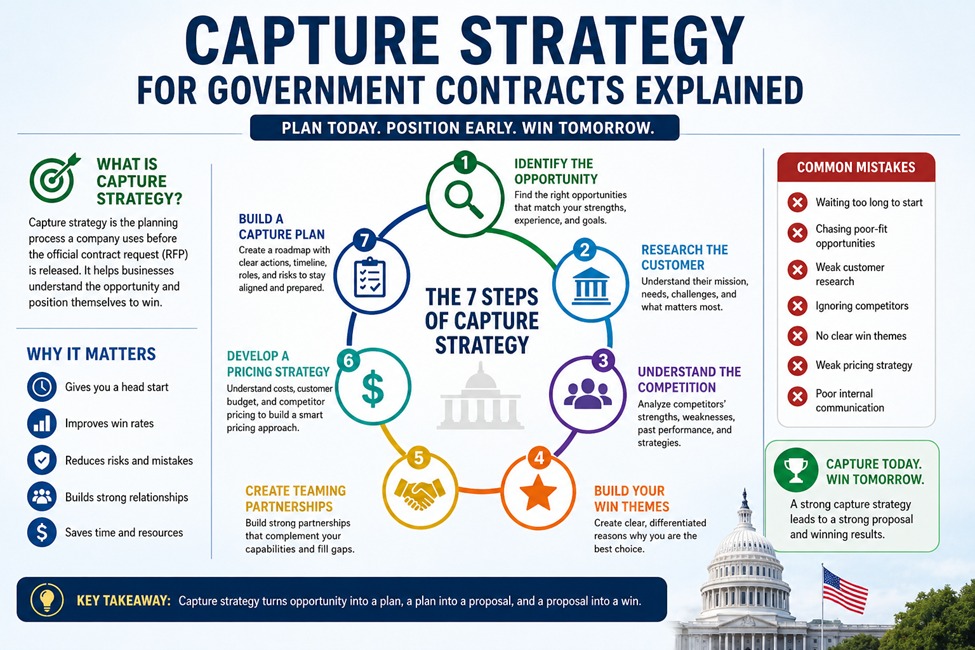
Winning a government contract does not start when the proposal is written. It starts much earlier with something called a capture strategy.
Capture strategy is the planning process a company uses before the official contract request is released. It helps businesses prepare, understand the opportunity, and improve their chances of winning.
Think of it like preparing for a big game. You do not just show up and hope to win. You study the rules, learn about the competition, understand what the customer wants, and build a strong plan.
That is exactly what a capture strategy does for government contracts.
What is a Capture Strategy?
Capture strategy is the step before proposal writing. It focuses on learning everything possible about a government contract opportunity before the Request for Proposal, or RFP, is released.
The goal is simple: position your company to win.
This means understanding:
- What the government agency needs
- Who the decision-makers are
- What problems they want solved
- Who your competitors are
- What makes your company the best choice
Capture strategy helps you stop guessing and start planning.
Why Capture Strategy Matters
Many companies wait until the RFP is published before taking action. By then, it is often too late.
Strong competitors have already been preparing for months. They may have already built relationships, studied the customer, created teaming partnerships, and planned their pricing.
Capture strategy gives you a head start.
It helps you:
- Save time
- Reduce mistakes
- Improve win rates
- Build stronger proposals
- Make smarter business decisions
Without a capture strategy, proposal writing becomes reactive instead of strategic.
Step 1: Identify the Opportunity
The first step is finding the right contract opportunity. Not every contract is a good fit.
You should look for opportunities that match:
- Your services
- Your experience
- Your certifications
- Your team size
- Your financial capacity
Chasing every opportunity wastes time and money. Focus on contracts where your company has a real chance to win. This is called a qualification.
Step 2: Research the Customer
The government agency is your customer. You need to understand what they care about.
Ask questions like:
- What is their mission?
- What problems are they trying to solve?
- What has gone wrong in the past?
- Who are the decision-makers?
- What matters most to them: price, speed, quality, or innovation?
The better you understand the customer, the stronger your strategy becomes. Good capture teams spend time listening, learning, and researching.
Step 3: Understand the Competition
You are rarely the only company trying to win. That means you must study your competitors.
Look at:
- Their past contract wins
- Their pricing style
- Their strengths and weaknesses
- Their customer relationships
- Their certifications and partnerships
This helps you find your competitive advantage. Ask yourself: Why should the government choose us instead of them?
That answer becomes a key part of your capture strategy.
Step 4: Build Your Win Themes
Win themes are the clear reasons why your company should win the contract. They are not just nice words. They are evidence-based advantages.
Examples include:
- Lower overall cost
- Faster delivery
- Strong past performance
- Special certifications
- Better technology
- Local presence
- Experienced leadership team
Your win themes should directly connect to what the customer values most. Strong win themes make your proposal stronger later.
Step 5: Create Teaming Partnerships
Sometimes, one company cannot handle the full contract alone. This is where teaming comes in.
You may partner with:
- Subcontractors
- Small businesses
- Technical experts
- Local service providers
- Specialized consultants
These partnerships can fill skill gaps and improve compliance. For example, if a contract requires cybersecurity certification and you do not have it, a qualified partner may solve that problem.
Good partnerships make your company stronger.
Step 6: Develop a Pricing Strategy
Price matters in government contracts. But the lowest price does not always win. You need a smart pricing strategy.
This means understanding:
- Customer budget expectations
- Competitor pricing behavior
- Your real delivery costs
- Profit goals
- Risk factors
A capture strategy helps you prepare pricing early instead of rushing later. This reduces errors and improves confidence.
Step 7: Build a Capture Plan
A capture plan is the written roadmap for winning the contract.
It includes:
- Opportunity details
- Customer insights
- Competitor analysis
- Win themes
- Teaming partners
- Pricing approach
- Proposal schedule
- Risk management steps
This keeps everyone aligned. Sales, leadership, proposal teams, and operations should all work from the same plan. Without a clear capture plan, teams often move in different directions.
Common Mistakes in Capture Strategy
Many businesses make the same mistakes.
These include:
- Waiting too long to start
- Chasing poor-fit opportunities
- Ignoring competitors
- Weak customer research
- No pricing strategy
- No clear win themes
- Poor internal communication
Capture strategy is not just paperwork. It is active planning. The earlier it starts, the stronger it becomes.
Capture Strategy vs Proposal Writing
These two are connected, but they are not the same. Capture strategy happens before the RFP. Proposal writing happens after the RFP.
Capture asks:
“How do we win?”
Proposal writing answers:
“Here is why we should win.”
A strong proposal usually comes from a strong capture strategy. If capture is weak, proposal writing becomes much harder.
Final Thoughts
Government contracts are competitive, and winning takes more than good writing. It takes preparation.
Capture strategy helps businesses understand the opportunity, prepare smartly, and position themselves before the competition gets ahead. It turns random bidding into a clear, focused process. Instead of reacting at the last minute, you move with purpose.
That is the real power of the capture strategy. The best government contractors do not wait for opportunities. They prepare for them long before the proposal is due.