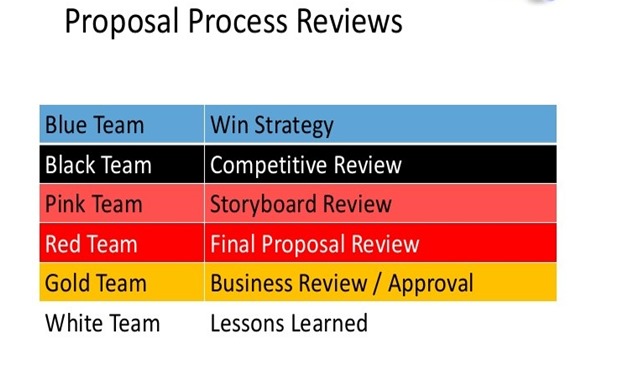
Color-team reviews aren’t a ceremony; they’re quality control built to raise scores and reduce risk before you submit. Run them with intent, and you’ll catch gaps while there’s still time to fix them. Here’s how Pink, Red, and Gold Teams workwhat they target, who should be in the room, and what “good” looks like at each gate.
Why Color Reviews Exist
Evaluators grade against Section M. Color reviews mirror that. Each team asks a different question:
- Pink: Are we answering the right things, in the right places?
- Red: Will this score strengths and minimize weaknesses?
- Gold: Is this a polished, compliant, zero-defect package?
Treat each review like a formal milestone with entry/exit criteria, not a casual read-through.
Pink Team: Structure, Coverage, and Clarity
When: Once a full draft exists (60–70% complete).
Goal: Validate structure, completeness, and traceability to Section L/M.
Focus areas
- Outline fidelity: Headings, numbering, and sequence match the RFP.
- Coverage: Every “shall/must” appears in the draft; no orphan requirements.
- Intent clarity: Each section opens with a short “compliance + benefit” statement.
- Evidence placeholders: Past performance vignettes, metrics, resumes, and graphics are identified if rough.
Team composition
- Proposal manager (facilitator), volume leads, compliance lead, solution architect, and one person who wasn’t involved in writing.
Outputs
- A gap list tied to the compliance matrix (missing content, wrong section, thin detail).
- A graphics plan (what visuals, where, and who owns them).
- Page budget adjustments to reflect where the scoring weight actually lives.
Pass criteria
- No unmapped requirements.
- All sections have a visible “how,” not just SOW restatements.
- Writers leave with clear, dated assignments.
Red Team: Scoring and Risk
When: Mid-late content complete (85–95%), graphics drafted, pricing narrative aligned.
Goal: Pressure-test like the government. Red Team reads as evaluators, not editors.
Focus areas
- Section M scoring: Are there clear strengths (exceeds requirement, reduces risk/cost, improves performance)? Are weaknesses or deficiencies lurking?
- Relevance and proof: Past performance mirrors scope, complexity, and environment; metrics are credible.
- Risk story: Risks are named with mitigations, triggers, and owners; governance is practical.
- Traceability to price: BOE/CLINs reflect the technical approach disconnects that invite realism flags.
- Evaluator usability: Headings, callouts, and captions make strengths easy to find.
Team composition
- People who did not write the draft: senior capture, program SMEs from other accounts, pricing lead, contracts/compliance, and a tough editor who thinks like a grader.
How to run it
- Give Red Team only the RFP, the draft, and the compliance matrix, nothing else.
- Reviewers write findings in the evaluator format: Factor to Observation to Impact (strength/weakness) to Fix.
- Score each factor using the RFP’s own rating scale (Outstanding/Good/etc, or equivalent).
Outputs
- A Red Book: prioritized findings, with owner and fix-by date.
- A cut list: content to delete to hit page limits without losing score.
- Price/story deltas for reconciliation (e.g., staffing hours vs. narrative).
Pass criteria
- Each subfactor contains at least 2–3 documented strengths.
- Weaknesses have specific, feasible fixes.
- Price and technical tell the same story.
Gold Team: Executive Polish and Production Readiness
When: Final content locked, only minor edits ahead (95–100%).
Goal: Submission-grade quality: consistent, compliant, and production-ready.
Focus areas
- Message consistency: Win themes and value propositions match across volumes; no contradictions.
- Plain language: Crisp sentences, active voice, measurable claims.
- Visual clarity: Graphics are legible at print size; captions state the benefit, not just describe the picture.
- Packaging: Page limits, fonts, margins, bookmarks, file names, tabs, and required forms.
- Accessibility: Searchable PDFs; working internal links if allowed.
Team composition
- Executive sponsor, proposal manager, volume owners, production lead, contracts. Minimal SME is not a rewrite session.
Outputs
- Gold edits (tighten language, align terminology).
- Production checklist signed off: forms, reps & certs, signatures, OCI statements, subcontractor letters, and attachments.
- Submission rehearsal plan for the portal or delivery method.
Pass criteria
- Zero compliance defects.
- Clean, consistent narrative and visuals.
- Submission pack assembled and tested.
Timelines That Work (Example for a 3-Week Turn)
- Day 1–3: Decode RFP; outline; compliance matrix; kickoff.
- Day 4–8: Draft to outline; graphics wireframes; initial BOE.
- Day 9: Pink Team to 48-hour recovery.
- Day 12–14: Complete content; finalize graphics; price alignment.
- Day 15: Red Team to 72-hour recovery.
- Day 18–19: Lock content; production formatting; portal test.
- Day 20: Gold Team to light edits; finalize PDFs.
- Day 21: Submit with receipts.
Adjust cadence for larger bids, but protect recovery windows. Reviews without recovery time are theater.
Best Practices Across All Colors
- One owner per section. Clear accountability beats committee writing.
- Single source of truth. Keep the compliance matrix live and visible; update after every amendment.
- Finding discipline. Every review comment must include impact and a proposed fix.
- Cut ruthlessly. If a sentence doesn’t raise score or prove compliance, delete it.
- Close the loop. Track findings to closure; don’t re-litigate resolved items.
Bottom Line
Pink, Red, and Gold aren’t optional. Pink builds the skeleton, Red loads the score, and Gold makes it bulletproof. Run each review with clear goals, the right people, and real pass criteria, and you’ll submit proposals that are compliant, compelling, and ready to win.