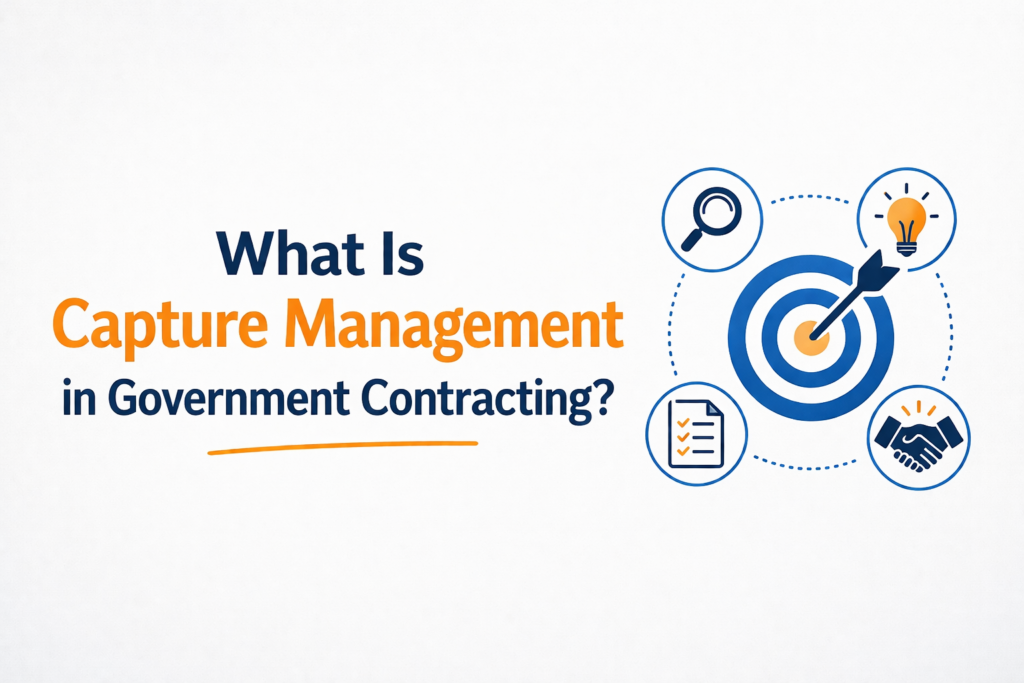
Capture management is what happens before the proposal. Most contractors focus on writing proposals. Strong contractors focus on winning before the proposal is even released. That is what capture management is about. It is the process of finding opportunities early, understanding what the government needs, building relationships, and shaping the deal before it becomes competitive.
If you skip capture management, you are reacting. If you use it well, you are preparing to win.
Simple Definition of Capture Management
Capture management is the process of planning and positioning your business to win a specific government contract.
It happens before the RFP is released. Instead of waiting for an opportunity, you actively prepare for it.
Why Capture Management Matters
Many contracts are influenced long before they are officially announced.
Agencies:
- Talk to vendors early
- Research the market
- Shape requirements based on input
If you are not part of that early stage, you are starting behind.
Capture management helps you:
- Understand the opportunity early
- Build trust with decision makers
- Improve your chances of winning
It shifts you from competing blindly to competing with insight.
Capture Management vs Proposal Management
These two are often confused, but they are very different.
Capture Management
- Happens before the RFP
- Focuses on strategy and positioning
- Builds relationships and knowledge
Proposal Management
- Happens after the RFP
- Focuses on writing and submitting
- Responds to requirements
Capture management is proactive. Proposal management is reactive.
Key Stages of Capture Management
Capture management is not one action. It is a series of steps that build on each other.
1 Opportunity Identification
This is where you find potential contracts early.
You look at:
- Sources Sought notices
- RFIs
- Agency forecasts
The goal is to spot opportunities before they become competitive.
2 Research and Intelligence
Once you find an opportunity, you learn everything you can.
This includes:
- The agency’s mission
- Current contractors
- Past contracts
- Budget trends
The more you know, the stronger your strategy.
3 Relationship Building
Government contracting is not just paperwork. It is also about trust.
During this stage, you:
- Connect with agency contacts
- Attend events
- Respond to early notices
You are not selling aggressively. You are building familiarity.
4 Solution Positioning
Now you start shaping how you will solve the problem.
You:
- Align your services with the agency’s needs
- Adjust your approach based on feedback
- Highlight what makes you different
This is where your strategy becomes clear.
5 Teaming and Partnerships
Sometimes you cannot win alone.
Capture management often includes:
- Finding partners
- Building subcontracting teams
- Filling capability gaps
Strong teams increase your chances of winning.
6 Win Strategy Development
This is where everything comes together.
You define:
- Why you will win
- What makes you the best choice
- How will you present your value
By the time the RFP is released, your direction is already set.
What a Capture Manager Does
In larger organizations, capture management is handled by a dedicated role.
A capture manager is responsible for:
- Tracking opportunities
- Leading research efforts
- Building relationships
- Developing strategy
- Coordinating teams
They focus on winning the opportunity before the proposal even starts.
In smaller businesses, this role is often handled by the owner or leadership team.
Benefits of Capture Management
Capture management creates a clear advantage.
Better Understanding
You know what the agency wants before it is written in the RFP.
Stronger Proposals
Your proposal is more focused because you already understand the problem.
Higher Win Rates
You are not guessing. You are aligned with the opportunity.
Reduced Competition Pressure
You are not competing cold. You are competing with context.
Common Capture Management Mistakes
Many contractors either skip capture management or approach it the wrong way.
Waiting Too Late
If you start at the RFP stage, you miss the biggest advantage.
Weak Research
Not understanding the agency leads to generic proposals.
Over-Selling Early
Early stages are about listening and learning, not pushing aggressively.
Ignoring Teaming
Trying to do everything alone can limit your chances.
Avoiding these mistakes can improve your results quickly.
How to Start Capture Management
You do not need a large team to begin.
Start with simple steps.
Track Opportunities Early
Watch for Sources Sought and RFIs.
Build a Basic Plan
Choose one opportunity and focus on it.
Learn the Agency
Understand their priorities and challenges.
Stay Consistent
Capture management is not a one-time effort. It is ongoing.
Even small actions can make a big difference over time.
When Capture Management Makes the Biggest Impact
Capture management matters most for:
- High-value contracts
- Competitive opportunities
- Long-term projects
The larger the opportunity, the more important early positioning becomes.
Conclusion
Capture management is the work that happens before the work. It is how you prepare, position, and plan to win government contracts before they become competitive.
Most contractors focus only on proposals. The ones that win consistently invest time earlier. If you start using capture management, you move from reacting to opportunities to shaping them.
That shift is what separates average contractors from successful ones.