Some government contracts are simple. You do the work once, get paid, and move on. An IDIQ contract works differently.
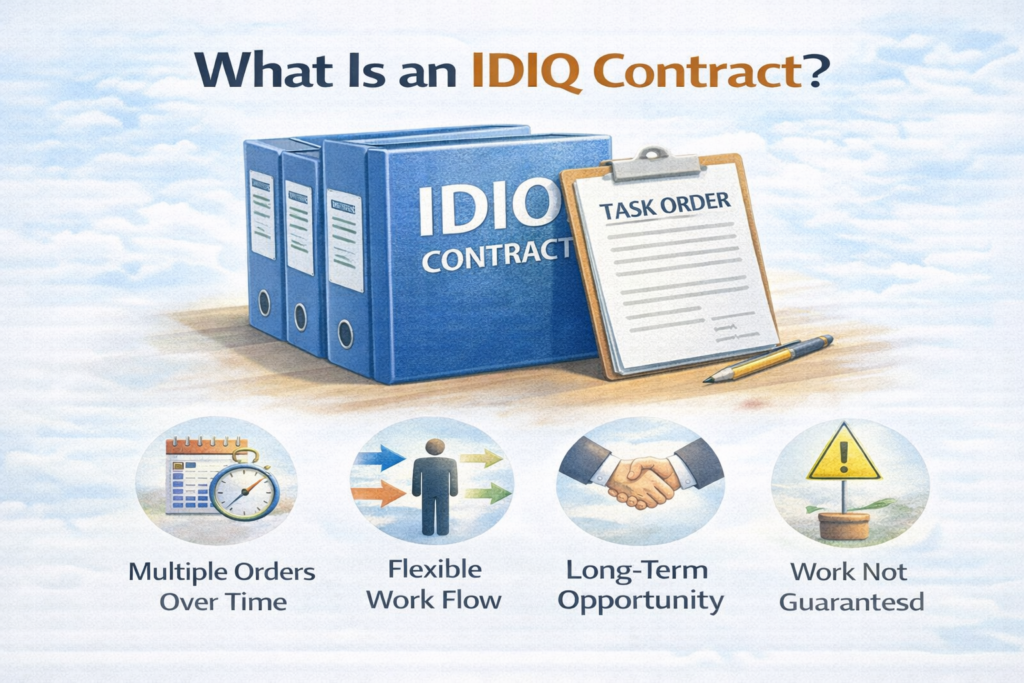
Instead of one fixed job, it creates a long-term agreement where work is ordered over time. You are not hired for one project. You are placed in a position to receive multiple projects.
This structure is very common in federal contracting, and understanding it can open the door to consistent work.
Quick Definition
IDIQ stands for Indefinite Delivery Indefinite Quantity.
That may sound complicated, but the meaning is simple.
- Indefinite delivery means the timing of the work is not fixed
- Indefinite quantity means the amount of work is not fixed
The government knows it will need something, but it does not know exactly when or how much.
So instead of creating a new contract every time, it creates one flexible contract and places orders under it.
How an IDIQ Contract Actually Works
Think of an IDIQ contract as a framework.
The government selects one or more contractors and signs a master agreement with them. This agreement sets the rules, pricing structure, and scope of work.
After that, the real work happens through something called task orders or delivery orders.
The Process in Simple Terms
- The government awards an IDIQ contract to one or more companies
- Work is not given all at once
- The agency issues task orders over time
- Contractors complete each order as it comes
Instead of chasing new contracts every time, you are already inside the system.
Single Award vs Multiple Award IDIQ
Not all IDIQ contracts are the same. There are two main types.
Single Award IDIQ
In this setup, only one company wins the contract. All future work orders go directly to that company. This is the simplest structure and offers the most stability if you win it.
Multiple Award IDIQ
In this setup, several companies are selected. When new work comes up, those companies compete for each task order. This is very common.
You are not competing with the entire market anymore, but you are still competing within a smaller group.
Key Features of IDIQ Contracts
IDIQ contracts have a few defining characteristics that make them unique.
- Flexible Work Flow: The government can order work when it needs it. This makes it easier for agencies to manage changing needs.
- Minimum and Maximum Limits: Most IDIQ contracts include a minimum amount of work the government guarantees and a maximum limit it cannot exceed.
- For example, a contract might guarantee at least a small amount of work but allow for much larger totals over time.
- Long-term Duration: IDIQ contracts often last several years. This gives contractors the chance to build ongoing relationships.
- Task-Based Execution: Work is broken into smaller assignments instead of one large project.
Where IDIQ Contracts Are Used
IDIQ contracts are used across many industries.
You will often see them in:
- IT and software services
- Construction and engineering
- Consulting and professional services
- Maintenance and support
They are especially useful when the government expects repeated needs but cannot define everything up front.
Why Agencies Use IDIQ Contracts
IDIQ contracts are designed for efficiency. Instead of repeating the same procurement process again and again, agencies can move faster.
- Saves Time: The contract is already in place. Agencies only need to issue task orders.
- Reduces Administrative Work: Less paperwork and fewer full competitions are required.
- Handles Uncertainty: Agencies do not always know how much work they will need. IDIQ contracts allow flexibility.
Why Contractors Like IDIQ Contracts
From a business perspective, IDIQ contracts can be very valuable.
- Ongoing Opportunities: You are positioned to receive multiple assignments over time instead of just one.
- Lower Competition Pool: In multiple award contracts, you are only competing against a small group of approved vendors.
- Relationship Building: Working on multiple task orders helps you build stronger relationships with agencies.
- Revenue Potential: While not guaranteed, the total value over time can be significant.
What to Watch Out For
IDIQ contracts are powerful, but they are not automatic wins.
Work Is Not Guaranteed
Winning an IDIQ contract does not mean you will receive a lot of work. Especially in multiple award setups, you still need to compete for each task order.
Continuous Effort Required
You must stay active, respond to task orders, and perform well to keep winning more work.
Performance Matters
Each task order affects your reputation. Strong performance increases your chances of future awards.
How to Win Work Under an IDIQ
Getting the contract is only the first step.
Respond Quickly
Task orders often have shorter timelines. Being ready gives you an advantage.
Stay Competitive
Even within a small group, pricing and quality still matter.
Understand the Agency
The better you understand the agency’s needs, the stronger your responses will be.
Deliver Strong Results
Good performance leads to more opportunities.
When IDIQ Contracts Make Sense
IDIQ contracts are best for businesses that:
- Want long-term government work
- Can handle multiple projects over time
- Are comfortable competing within a smaller group
They are less suited for businesses looking for one quick project.
Final Perspective
An IDIQ contract is not just about one job. It is about access. It gives you a seat at the table for future work, sometimes for years.
The real value is not just in winning the contract, but in how you use it. The businesses that succeed are the ones that stay active, respond consistently, and build trust with every task order.
If you approach it the right way, an IDIQ contract can become a steady source of growth rather than a one-time opportunity.